- All
- Product Name
- Product Keyword
- Product Model
- Product Summary
- Product Description
- Multi Field Search
Views: 0 Author: Site Editor Publish Time: 2025-08-14 Origin: Site
Setting | Common Voltage Ranges | Typical Applications |
|---|---|---|
Industrial | 11 kV to 36 kV (compact substations), up to 132 kV (mobile substations) | Manufacturing plants, logistics hubs, technology parks |
Urban | 11 kV to 36 kV (compact and pad-mounted substations) | Residential neighborhoods, shopping malls, office buildings |
Rural | 11 kV to 33 kV (primary distribution), stepping down to 400 V | Remote villages, agricultural areas |
Prefabricated substations are made in factories. They help deliver electricity quickly and safely. People use them in cities, factories, and the countryside.
They have important parts like high-voltage switchgear and transformers. They also have low-voltage equipment. All these parts stay safe inside strong, weatherproof boxes.
These substations are easy to set up fast. They are very safe and simple to expand. They save time and money compared to regular substations.
Workers test each unit in the factory and at the site. This makes sure every unit works well. It also checks that they meet strict safety and quality rules before use.
Prefabricated substations work in many places. They can be used in busy cities or on faraway farms. They help with growing power needs and green energy projects.
Prefabricated substations have many important parts inside a strong shell. These parts work together to give safe and steady electricity. The factory builds and checks the units before sending them out. This helps keep the quality high and makes setup quick.
High-voltage switchgear helps control and protect electricity from the power grid. It has circuit breakers, switches, and relays. These devices work with voltages of 75 kV or more. They are very important for high voltage substation jobs. There are air-insulated, gas-insulated, and hybrid switchgear types. Air-insulated switchgear is good for open areas and needs little care. Gas-insulated switchgear is small and quiet, so it fits in cities. Hybrid switchgear mixes both types for more choices.
Switchgear Type | Key Performance Characteristics |
|---|---|
Air-Insulated Switchgear (AIS) | Cost-efficient, reliable, low maintenance, suitable for open areas, rated up to 800 kV and 8,000 A |
Gas-Insulated Switchgear (GIS) | Compact, reliable, low noise, fits urban sites, rated from 72.5 kV to 550 kV |
Mixed Technology (Hybrid) Substations | Modular, space-saving, easy access, ideal for upgrades and expansions |
High-voltage switchgear keeps the substation safe from problems. It lets workers do repairs safely. It also connects with medium voltage switchgear and low voltage switchgear for full control.
Transformers lower high-voltage electricity so it is safe to use. The main kind is the distribution transformer. It steps down power for homes, factories, and offices. Prefabricated substations use step-down transformers, pad-mounted transformers, and small substation transformers. These can handle voltages from 6 kV to 230 kV. Power ratings go from 1 kVA to hundreds of MVA, depending on what is needed.
Transformer Type | Application in Prefabricated Substations | Voltage Classes (kV) | Efficiency Ratings |
|---|---|---|---|
Step-down Transformer | Main transformer for substations, including portable units | 69, 110, 132, 138, 230 kV | DOE standards referenced |
Pad-mounted Transformer | Used in compact substations, handles medium to low voltages | 6 kV to 35 kV | Not explicitly stated |
Small Substation Transformer | Used in portable substations | Medium voltage range | Not explicitly stated |
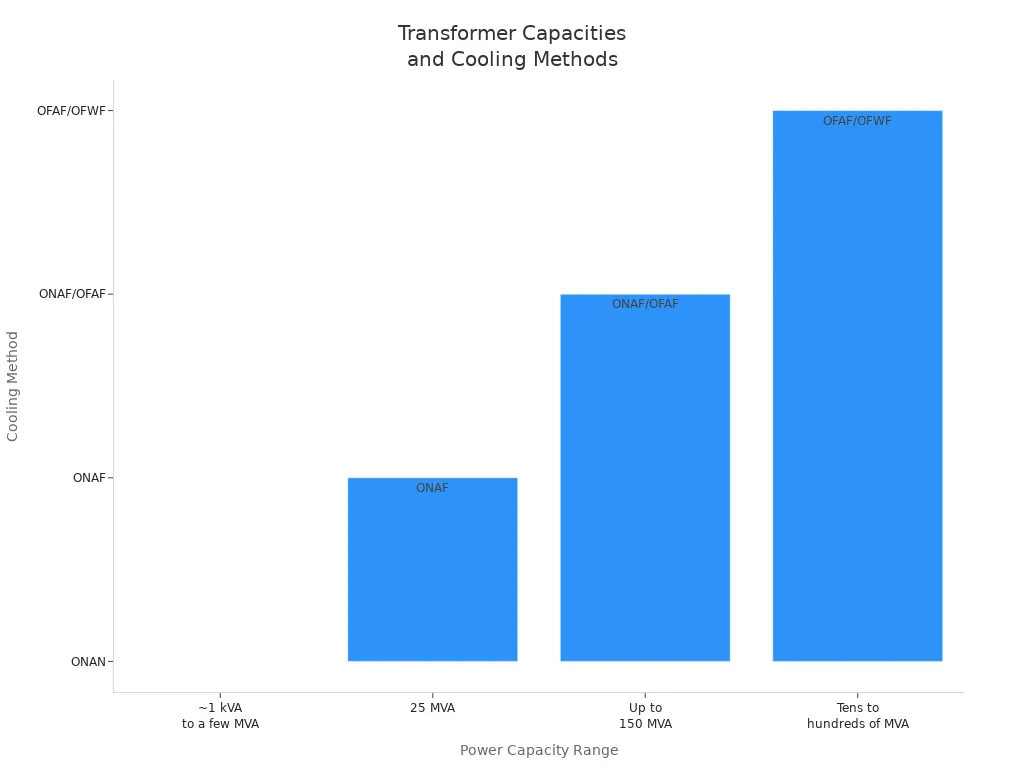
Cooling keeps transformers safe and working well. ONAN cooling uses oil and air for small units. ONAF cooling adds fans for bigger transformers. OFAF and OFWF cooling help very large transformers handle more power.
Distribution transformers in prefabricated substations support many voltage levels and power needs. They work with high-voltage switchgear and low voltage switchgear to deliver electricity safely.
Low-voltage equipment sends power to people who use it. It has low voltage switchgear, switchboards, cabinets, and fuses. These parts stop overloads and short circuits. They also measure how much electricity is used and help make power better.
Low-Voltage Equipment | Main Functions |
|---|---|
Low voltage switchboards | Distribute and control low-voltage power to end users |
Low-voltage power distribution cabinets | Manage distribution of low-voltage electricity |
Load switches | Switch and disconnect low-voltage loads |
Current-limiting fuses | Protect against overload and short-circuit |
Plastic case automatic air switches | Ensure safe operation and protect against faults |
Metering equipment | Measure electricity consumption |
Reactive power compensation devices | Improve power quality and efficiency |
Monitoring and control equipment | Manage operations and enable remote monitoring |
Distribution transformers work with low voltage switchgear to lower power and send it to homes, schools, and businesses. These systems also have protection and control features. Anti-fouling and anti-humidity designs keep equipment safe in tough places. Grounding systems protect people and equipment from electrical faults. Smart monitoring lets people control and check data from far away.
The protective enclosure keeps all substation equipment safe from weather, animals, and theft. Factories use galvanized steel and container technology to build these shells. The enclosure does not rust for up to 20 years. Aluminum alloy plates and fire-proof insulation make it even safer. Air conditioning and dehumidifiers help equipment work in temperatures from -40℃ to +40℃.
The enclosure keeps out water, rust, dust, rodents, fire, thieves, and heat. It covers all live parts to stop electric shock accidents.
Factories design the enclosure to fit in cities or rural areas. Prefabricated substations use standard designs and parts, so setup is fast and easy. The enclosure holds the distribution transformer, high-voltage switchgear, medium voltage switchgear, and low voltage switchgear, keeping everything safe.
Factories follow careful steps to build prefabricated substations:
Custom design starts with checking power needs and planning the layout.
Standardized building uses tested parts in climate-controlled rooms.
Simulation testing checks insulation, heat, and load performance.
Delivery makes sure the substation gets to the site safely.
Onsite assembly puts all the parts together and connects them.
Testing and inspection make sure the substation works safely and well.
This process helps keep quality high and lowers mistakes during setup. Prefabricated substations arrive ready for fast setup and safe use.
Prefabricated substations help move electricity to homes and businesses. They take power from the main grid and send it where it is needed. Their modular design means they can be set up fast. It is easy to add more parts if needed. These substations use special switchgear and transformers. This helps control electricity safely and efficiently.
The table below shows how prefabricated substations compare to traditional ones:
Aspect | Prefabricated Substations (Box-type) | Traditional Substations |
|---|---|---|
Space Efficiency | Small modular design, fits in tight spaces, flexible layout | Needs bigger area for transformers and equipment |
Construction Time | Built in a factory, quick to install on site, saves time | Takes longer to build and set up equipment |
Safety | Closed design keeps equipment safe from weather and damage | Often open, more risk from outside problems |
Environmental Impact | Has devices to stop noise and leaks, less pollution | May need extra controls for noise and environment |
Operating Costs | Lower costs because it needs less fixing, works well | Costs more to keep running and fix problems |
Flexibility | Easy to expand or change without big building work | Harder to expand, needs big changes to structure |
Aesthetics | Looks good, blends in with surroundings, helps city look nice | Simple look, does not fit in as well |
Prefabricated substations can handle transformer sizes from 2,000 kVA to 10,000 kVA. This shows how much power they can manage. Their design can be changed to fit different needs. Factory testing makes sure they work well and are reliable. Fast setup means less waiting and helps with urgent power needs.
Prefabricated substations make power distribution better by saving time, making things safer, and stopping system failures. Their design lets cities and factories grow easily and saves money.
Voltage transformation is very important in prefabricated substations. Transformers inside change high voltages to lower ones. This makes electricity safe for people and machines. Transformers use magnetic induction to do this job. They have two windings on a steel core. The number of turns in each winding sets the voltage.
For example, a transformer with a 480:120 ratio lowers voltage from 480 volts to 120 volts. Common voltage changes include going from 138 kV to 12 kV, or from 11 kV to 400 V. Tap changers let workers adjust the output voltage. This keeps voltage steady when the load changes.
Prefabricated substations use copper or aluminum windings and steel cores. This helps save energy and makes them strong. Their design keeps the power grid stable. They can change voltage levels to fit homes, offices, and factories.
Flow control keeps the power system safe and steady. Smart protection devices find problems fast and fix them before they get worse. These devices use extra information and smart checks to spot faults and give backup protection.
Advanced Power Flow Control devices help balance loads on different lines. They change line reactance by adding voltage in a special way. This lets workers control power flow right away. If one line gets too much power, these devices move power to other lines. This stops blockages and keeps the grid working.
Prefabricated substations also use grounding systems, barriers, and remote monitoring. These help stop electrical faults. Automation tools like Intelligent Electronic Devices and protective relays find faults quickly and shut things down automatically. Fire detection and suppression systems add more safety.
Grounding systems give fault currents a safe path.
Barriers and warning signs keep people out.
Remote monitoring means fewer workers on site, so accidents are less likely.
All these features help prefabricated substations give steady and safe power, even when there are problems or emergencies.
Factory testing makes sure each prefabricated compact substation is safe and high quality before it leaves the factory. Engineers check all the main parts, like the medium voltage switchgear, distribution transformer, and low voltage panel. They also test the enclosure to see if it is strong and can handle bad weather. The team uses rules from IEC 62271-202 and IEC 60076. These steps help make sure every prefabricated compact substation is safe and ready to use.
Aspect | Description |
|---|---|
Components Tested | Medium Voltage Switchgear, Distribution Transformer, Low Voltage Panel |
Enclosure | Galvanized steel, aluminum, or concrete with IP54 protection |
Testing Standards | IEC 62271-202, IEC 60076, IEEE C37.20 |
Testing Procedures | Dielectric strength, temperature rise, short-circuit resistance, enclosure protection |
Internal Layout | Separate compartments, fireproof barriers, ventilation |
Safety & Quality | Compliance with international standards, ready for integration |
The factory team follows simple steps for testing:
Decide what to test and who does each job.
Make sure everyone uses safety gear and follows safety rules.
Check if the assembly and wiring are done right.
Test all important parts and control systems.
Write down any problems and fix them.
Work with customers and inspectors to check the work.
Get the prefabricated compact substation ready to ship.
They also look at cable building, grounding, and bus setup. High voltage tests help find insulation problems early. Any problems must be fixed before the prefabricated compact substation leaves the factory.
On-site testing happens after the prefabricated compact substation gets to its new place. The team checks for damage and makes sure all the parts are there. Safety checks for lifting tools come first. Workers test the insulation of high and low voltage cables using a mega-ohm meter. They match cable circuits to design drawings and seal cable inlets to keep out dirt.
The team puts in grounding devices and checks their depth and resistance. If the prefabricated compact substation has been stored for a long time, they do extra insulation tests. Safety rules keep workers and equipment safe during setup. These steps help make sure the prefabricated compact substation works safely and well. Testing at the site is the last step before the unit starts working for homes, factories, or cities.
Good compact substation testing, both in the factory and on-site, makes sure every prefabricated compact substation gives safe and steady power.
A prefabricated compact substation gets to the site after planning. Special trucks move the unit safely. Teams follow rules for weight and size. The whole truck cannot weigh more than 55 tons. The height must stay under 4 meters. The width cannot be more than 3 meters. These rules help the team follow road laws and keep everyone safe.
Aspect | Requirement / Description |
|---|---|
Gross vehicle weight | ≤ 55 tons |
Transport height | ≤ 4 meters |
Transport width | ≤ 3 meters |
Transformer weight (optimized) | ~40.5 tons |
Vehicle configuration | Three-car solution: GIS car, Transformer car, Medium voltage car |
Equipment spacing (minimum) | Transformer to HGIS ≥ 1000mm, Transformer to medium voltage equipment ≥ 1000mm |
Safety protection | Fixed fence ≥ 1.7m height around substation |
Transport trucks use electric or hydraulic legs for support. Mechanical locks keep the substation steady. Leveling tools stop the unit from tilting. The team leaves at least 1000mm between the transformer and switchgear. Safety fences taller than 1.7 meters protect people and equipment. Vibration-resistant switchgear like HGIS stops damage during travel. The team uses strong steel and special cooling to lower weight.
Commissioning a prefabricated compact substation uses simple steps. The team checks each part to make sure it works right.
Planning and Design
The team picks the site and makes the design. They get permits and approvals.
Construction and Installation
Workers build the base and put in the substation. They set up all electrical and support systems.
Testing
The team does insulation resistance tests and dielectric tests. They check all wiring and test transformers, circuit breakers, and relays.
Final Commissioning
Load tests copy real working conditions. The team checks relay coordination and adjusts the system.
Handover and Documentation
Workers teach operators and give manuals. They do a final check and get approval.
Key checks include insulation resistance, dielectric strength, and tests for main parts. The team also tests protection and control systems like SCADA. Load testing shows the substation can handle real power needs. Good commissioning lowers future compact substation maintenance and keeps the system working well.
Regular compact substation maintenance after setup helps stop problems and makes the prefabricated compact substation last longer.
Prefabricated substations can be set up much faster than regular substations. In Germany, teams put in compact substation units at many sites in just weeks. Regular substations can take months to finish. The modular design and factory work mean less time and money spent on site. Most setups are done in 5 to 8 days. There is not much building work needed because the unit comes ready to use. Fast setup keeps power on during upgrades or emergencies.
Units made in the factory are always high quality.
Plug-and-play parts make setup easy for workers.
Many substations can be installed quickly, even in busy cities.
Prefabricated substations can be changed to fit many needs. Makers offer custom choices for power, voltage, and safety. Some units can be moved to new places if needed. Special safety systems protect against arc faults and overloads. Operators can add energy storage or connect solar and wind power. Strong materials let these substations work in tough weather. Custom shapes and colors help them fit in with their surroundings.
Custom sizes and layouts fit each project.
Security includes locks, alarms, and fire protection.
Weatherproof and insulated designs work inside or outside.
Prefabricated compact substation units follow strict safety and quality rules. Most meet IEC 62271-202 and ISO standards for safety and the environment. Factory tests check for strong insulation, heat, and arc fault safety. CE marking and other labels show they meet world rules. Modular design and standard parts make repairs easy and fast. Factory assembly lowers the chance of mistakes or problems.
Aspect | Prefabricated Substations | Traditional Substations |
|---|---|---|
Quality Control | High, factory-tested | Variable, site-dependent |
Failure Rates | Low, consistent | Higher, more variable |
Maintenance | Simple, modular | Complex, less modular |
Prefabricated substations are used in many places. Factories, mines, and oil fields use them for steady power. Solar and wind farms use them for quick grid connection and energy storage. In cities, they power malls, hospitals, and data centers where space and looks matter. Rural areas get easy setup and better electricity. Both short-term and long-term projects use these units. For example, solar parks in Dubai and rural projects in Kenya show how these substations help people all over the world.
Prefabricated substations are quick to install, save money, are flexible, and keep people safe in many industries and communities.
Prefabricated substations give safe and steady power. They use modular designs and new technology. Transformers and switchgear help control the electricity. These parts keep everything working well. Many industries pick these substations for fast setup. They are easy to change and work very well. Cities are growing, and green energy needs are rising. This makes people want better power solutions. Teams look at how much power is needed and how much space there is. They also think about future growth. Prefabricated compact substation units help modern power systems. They can be set up quickly and work reliably.
A prefabricated substation gives electricity safely and fast. It uses parts made in a factory for quick setup. Cities, factories, and farms use them for steady power.
Most teams finish setup in under a week. The unit comes ready to use. Workers hook up cables and check the equipment. Quick setup saves time and money.
Tip: If teams plan early, they can install substations even faster.
Yes, these substations have tough enclosures. They stand up to rain, snow, and heat. Special coatings stop rust and damage. Air conditioning and insulation keep things safe.
Location | Common Uses |
|---|---|
Cities | Malls, hospitals, offices |
Factories | Production lines, storage |
Farms | Irrigation, grain storage |
Remote areas | Villages, mining sites |