- All
- Product Name
- Product Keyword
- Product Model
- Product Summary
- Product Description
- Multi Field Search
Views: 0 Author: Site Editor Publish Time: 2026-01-29 Origin: Site


When you operate a dry-type transformer, there is no insulating oil to buffer electrical stress, absorb moisture, or smooth temperature gradients. The insulation system becomes the only barrier between conductive parts, mechanical vibration, ambient humidity, and thermal cycling.
Field data and manufacturing practice show that most premature failures do not start in copper conductors or magnetic cores but in insulation layers—micro-cracks, partial discharge channels, moisture diffusion paths, or thermal embrittlement. Once these processes accelerate, electrical performance degrades rapidly, and structural repair becomes impractical.
In other words, the service life of a dry-type transformer is not completely governed by rated capacity or short-circuit impedance but by how well its insulation system resists electrical, thermal, mechanical, and environmental stress over decades of operation.
SHENGTE is an enterprise specializing in green power distribution, energy saving, and environmentally responsible transformer manufacturing. Its main product lines include epoxy resin cast dry type transformers (SCB10–SCB14 series), oil-immersed transformers, prefabricated substations, combined transformers, and high–low voltage switchgear systems. We have more than 15 years of manufacturing experience, and follow ISO9001 quality management with products aligned to IEC standards.
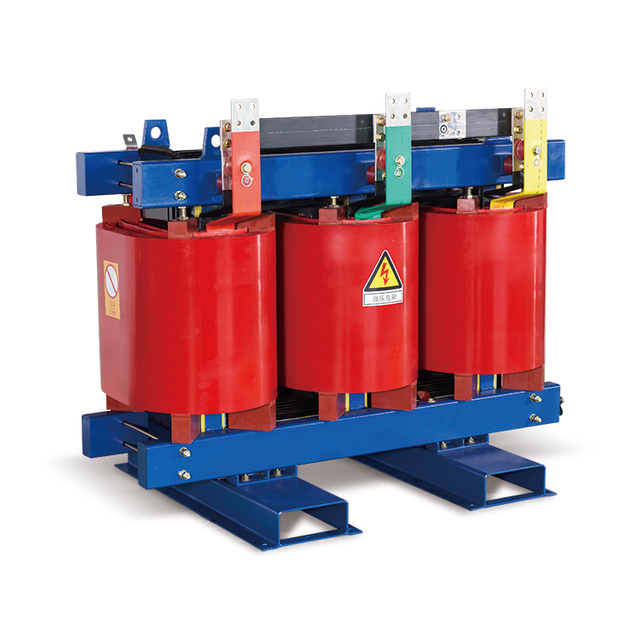
From an insulation perspective, the relevance lies in how its dry-type transformers are engineered. The high-voltage windings are vacuum cast with epoxy resin filled with mineral fillers, reinforced internally and externally with glass-fiber mesh to increase mechanical strength and resistance to short-circuit shock. Low-voltage windings adopt foil structures with axial cooling air ducts and DMD epoxy-impregnated insulation cloth between layers, forming an integral solidified block. The iron core uses high-grade cold-rolled silicon steel with fully inclined joints and epoxy surface coating to reduce no-load loss, current, and vibration. Cooling fans and intelligent temperature controllers are integrated to stabilize thermal stress during long-term operation.
These design choices illustrate a central idea—insulation is treated not as a passive coating, but as a structural system that defines mechanical stability, thermal limits, and electrical reliability.
Every load fluctuation changes winding temperature. Each temperature cycle expands and contracts polymer chains in epoxy resin and layered insulation cloth. Over thousands of cycles, micro-fractures appear. These micro-fractures are invisible at first, but they lower the dielectric strength and create sites for partial discharge.
Partial discharge does not need catastrophic voltage. It develops in microscopic voids and interfaces, gradually carbonizing material surfaces and forming conductive paths. Moisture accelerates this process by increasing dielectric constant and reducing surface resistivity.
Because these mechanisms progress internally, routine visual inspection rarely detects them until insulation breakdown is near. This is why insulation aging, not copper overheating, becomes the dominant end-of-life trigger for dry-type transformers.
Epoxy resin cast insulation replaces layered paper or tape structures with a single solid dielectric body, and vacuum casting removes trapped air and eliminates the primary source of partial discharge cavities.
Mineral fillers regulate thermal expansion and improve heat conduction, and glass-fiber mesh distributes mechanical stress and prevents crack propagation under electromagnetic forces.
The result is not simply higher breakdown voltage, but predictable electric-field geometry and long-term mechanical coherence. This combination directly slows the aging process, thus extending usable service life.
Discharge does not start from voltage alone but from geometry. Sharp edges, poor bonding between layers, and microscopic air pockets concentrate electric fields.
By using continuous resin encapsulation and impregnated inter-layer fabrics, the inception voltage of partial discharge is pushed upward. When discharges do not form, chemical erosion does not begin. Preventing the phenomenon is more effective than merely tolerating it.
Dry-type transformers are often installed indoors near load centers, basements, coastal zones, or industrial plants where humidity reaches saturation. Modern epoxy resin systems are hydrophobic and form sealed surfaces around conductors, which prevents moisture absorption that would otherwise reduce insulation resistance and promote surface tracking.
In practice, such transformers can operate in 100% humidity and resume service after shutdown without pre-drying, directly reducing downtime and avoiding moisture-induced aging.
Copper cross-section controls current density, but insulation geometry controls heat evacuation. Thick but poorly conductive insulation traps heat, raising hotspot temperature even under moderate load.
By integrating axial air ducts, thermally conductive fillers, and forced-air cooling paths, modern cast-resin systems allow continuous operation at elevated load while keeping insulation temperature within safe margins. Some designs support a 120% rated load under forced cooling without shortening service life.
Short-circuit currents generate radial and axial forces that attempt to deform windings instantly. In layered insulation systems, conductors may shift, damaging insulation edges and initiating long-term degradation.
Solid resin encapsulation bonds the winding into a rigid block, and glass-fiber reinforcement distributes mechanical load and prevents relative movement between layers. This structure preserves dielectric spacing after fault events and avoids hidden structural damage that would otherwise reduce lifespan.
Medium-capacity transformers often face irregular industrial loads, frequent starts, and voltage fluctuations. Insulation thickness must be sufficient for dielectric safety but not excessive to block heat flow.
A practical example is the SCB10 630kVA 6kV 400V Customized Three-Phase Resin Casting Dry-Type Power Transformer. Such designs optimize resin formulation, cooling duct geometry, and fiber reinforcement density to stabilize partial discharge levels, control hotspot temperature, and endure mechanical shock typical in factory distribution networks.

As capacity rises, electric-field gradients and thermal stress intensify. Resin shrinkage during curing may introduce internal stress that later forms cracks. High-capacity systems require staged curing profiles, controlled filler distribution, and multilayer insulation coordination to prevent internal delamination.
A reference configuration is the SCB10 1600 KVA 10 / 0.4 kV 3 Phase High Voltage Cast Resin Dry Type Power Transformer, whose insulation engineering becomes a structural technology, instead of a material selection task.

Oil-free systems eliminate fluid sampling and leak monitoring, but only stable insulation allows true maintenance-free operation.
Low partial discharge, moisture resistance, and controlled thermal aging reduce inspection frequency and unplanned shutdowns. Installation near load centers becomes feasible without fire-suppression infrastructure, lowering civil engineering costs. Over 20–30 years, insulation stability often contributes more to total cost reduction than marginal efficiency gains.
More insulation is not always safer. Excessive thickness increases thermal resistance, raising operating temperature and accelerating aging. High filler ratios improve rigidity but may increase brittleness, making cracks more likely under vibration.
Effective insulation design balances dielectric strength, thermal conduction, mechanical resilience, and manufacturability. Beyond this balance, added material reduces rather than extends service life.
A dry-type transformer does not age like metal but a polymer system under stress. Electrical performance, thermal endurance, and mechanical integrity all converge inside the insulation structure. Once that structure degrades, replacement is inevitable regardless of copper condition or core quality.
For long-term reliability, insulation material selection, processing method, and structural integration deserve the same attention as rated power or efficiency class.
Q1: Is epoxy resin always better than other insulation materials?
A: It offers strong advantages in discharge control, moisture resistance, and mechanical strength, but formulation quality and manufacturing discipline remain decisive.
Q2: Does insulation aging occur even at light load?
A: Yes. Thermal cycling and moisture diffusion continue at low load, slowly degrading polymer structure.
Q3: Can internal insulation defects be repaired on-site?
A: No. Damage inside cast-resin windings is irreversible and requires coil replacement.