- All
- Product Name
- Product Keyword
- Product Model
- Product Summary
- Product Description
- Multi Field Search
Views: 0 Author: Site Editor Publish Time: 2025-12-11 Origin: Site


The energy landscape is shifting beneath our feet. With the explosive rise of artificial intelligence and the rapid proliferation of AI data centers, power demands are no longer growing linearly—they are skyrocketing. Today’s high-performance computing racks require power densities that are often an order of magnitude higher than traditional enterprise setups. This surge places unprecedented pressure on global supply chains that were already fragile.
Power companies and builders are running into big problems. The wait times for key electrical gear have gone from months to years. In this tough spot, holding on to the old ways of putting up energy setups is a risk not many can take. So, the move across the field from regular on-site building to new prefabricated substations is not just a fad; it is a smart fix driven by the crisis. It is the only good way to keep jobs going when the supply line says "no more."
To understand why box-type transformer substations have suddenly become the MVP of the energy sector, we have to look at the storm brewing in the market. This isn't just about a few delayed shipments. It is a systemic bottleneck where the appetite for power has completely outpaced the world’s ability to manufacture and deliver the heavy equipment needed to transmit it.
Ten years ago, a standard data center rack might consume 5 to 10 kilowatts. Today, fueled by power-hungry GPUs training large language models, we are seeing racks demanding 50kW, 80kW, or even more. The grid connection required for a single new hyperscale campus now rivals the consumption of a mid-sized city.
But it is not just AI. We are simultaneously trying to electrify transportation and heating. Every EV charging station and every heat pump adds load to the local transformer substation. The demand is coming from all sides, all at once. The result is a scramble for capacity. Utilities are fighting over the same limited inventory of step-down transformers and switchgear. If a project manager relies on standard procurement timelines today, they are likely already behind schedule before they even break ground.
The problem would be manageable if manufacturers could simply "speed up." They can't. Manufacturing large power transformers is complex. It relies on specialized labor—winding experts and electrical engineers—that is in short supply. It also relies on grain-oriented electrical steel, a raw material that has seen volatile pricing and availability.
Traditional construction methods amplify this pain. In a standard "stick-built" scenario, you wait for the equipment to arrive before you can finish the station. If one component, like the compact substation transformer, is delayed by six months, the entire site sits idle. The civil works, the cabling, and the testing crews are all paralyzed. The traditional supply chain is linear and rigid; it snaps under pressure. This is where the flexibility of a package substation becomes the ultimate advantage.
When the front door is locked, you find a side door. Prefabricated substation manufacturers like SHENGTE have essentially created a bypass for the supply chain blockage. By changing how the substation is built, we can drastically alter when it is delivered. It moves the complexity off the muddy construction site and into a controlled factory flow.
The magic of the prefabricated compact substation lies in parallel processing. In a traditional build, you operate sequentially: you clear the land, pour the concrete foundation, wait for it to cure, erect the steel structures, and only then install the electrical equipment. It’s a slow, step-by-step crawl.
With prefabrication, the timeline is folded in half. While your civil engineering team is prepping the site and pouring a simple slab foundation, the substation is already being built, assembled, and wired hundreds of miles away in a factory.
By the time the concrete is dry at your site, the box-type transformer substations are ready to ship. This parallel workflow slashes project lead times significantly, allowing developers to energize their projects months earlier than the competition.
There is a sneaky time-waster in building called "commissioning." This is the part where experts check every wire, switch, and link to make sure it won't fail when you flip the switch. On a regular site, this goes on outside, often in bad weather, with teams fixing tough issues in the mud.
Prefabrication switches the game to "Plug and Play." Since the transformer substation gets put together in a factory, it gets fully checked before it hits the road. SHENGTE makes sure the high-voltage switchgear, the transformer, and the low-voltage setup are joined and fixed under good lights and steady settings.
This drops on-site setup and check time by up to 80% over old ways. When the unit shows up, you aren't making a substation; you are just hooking up the in and out cables. It turns a long building job into a simple drop-off task.
Speed is useless if the gear fails. Critics used to worry that "prefabricated" meant "temporary" or "cheap." That outdated view has been completely debunked. Today, a package substation often offers superior build quality compared to site-built counterparts because human error is minimized.
Imagine trying to weld a joint or wire a sensitive control panel while it is raining and the wind is blowing dust everywhere. That is the reality of on-site construction. It introduces variables that degrade quality.
In contrast, prefabricated substation manufacturers operate in clean, indoor environments. Welding is automated or performed by specialists at improved ergonomic angles. Electrical connections are torqued to exact specifications without the rush of a job site sunset.
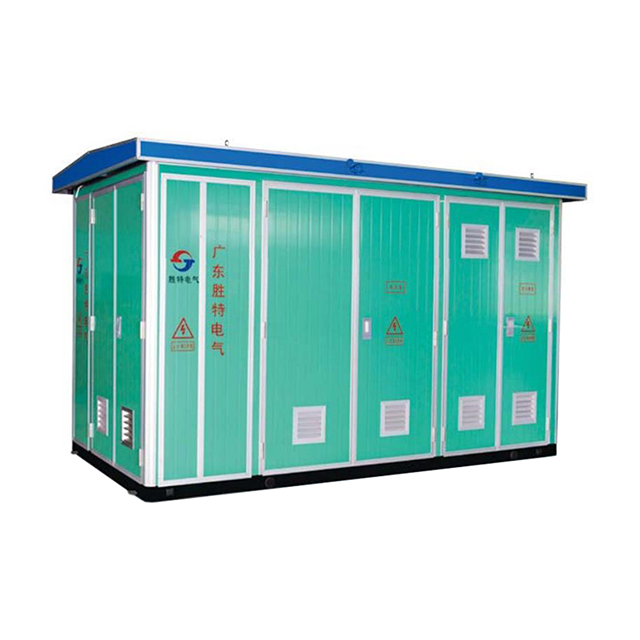
For example, SHENGTE's prefabricated substations utilize robust materials like stainless steel or aluminum alloy plates for the enclosure. They feature double-layer box structures with built-in thermal insulation. This level of precision—ensuring the unit is dust-proof, moisture-proof, and condensation-proof—is incredibly difficult to achieve consistently in the field. The factory environment guarantees that every compact substation transformer leaves the line meeting the exact same high standard.
Modern energy needs are popping up in difficult places. We are putting wind farms in salty coastal areas, mining operations in dusty deserts, and EV chargers in crowded city centers. A standard open-air substation is often too big or too fragile for these spots. This is where the prefabricated compact substation shines. Its footprint is typically one-third the size of a conventional setup. Different layout designs allow these units to squeeze into tight urban alleyways or beside busy highways without disrupting the environment.
Furthermore, the enclosure acts as a shield. Whether it is the corrosive salt air of a seaside wind farm or the heavy snow of a mountain data center, the internal components are protected. The box-type transformer substations are designed to be "four-proof": anti-corrosion, fire-proof, dust-proof, and theft-proof. This mechanical armor makes them the default choice for modernizing grid infrastructure in harsh environments.
When we look at the Total Cost of Ownership (TCO), the argument for prefabrication moves beyond just "getting it done fast." It becomes a financial imperative. In a world where capital is expensive and skilled maintenance labor is retiring, the equipment we install today needs to be efficient to run and easy to fix tomorrow.

The old way of planning power was to guess what you might need in 20 years and build a massive, expensive station today. That capital is dead money. Prefabricated substations allow for a modular approach. You can install exactly the capacity you need right now.
If your data center expands or your factory adds a new production line in two years, you simply drop in another package substation. This scalability allows businesses to align their infrastructure spend with their revenue growth. It avoids over-building and allows for the easy integration of renewable energy sources or battery storage down the road.
We also need to talk about waste. Construction sites are notorious for material waste—cutoff cables, scrap metal, and excess concrete. Factory production of a transformer substation is lean. Materials are optimized, and scrap is recycled immediately.
From an operational standpoint, the enclosed nature of these units reduces maintenance costs. Because the active parts are isolated from the elements, the cleaning intervals are longer, and the risk of animal intrusion (a surprisingly common cause of outages) is virtually eliminated. When you factor in the reduced land acquisition costs (due to the smaller footprint) and the savings on civil works, the compact substation transformer solution often comes out cheaper than the traditional build, despite the high-tech engineering involved.
The transformer supply crisis has shown a key weak spot in our way to build energy setups. We can't take the slow, custom, on-site build jobs anymore. Prefabricated substations stand for a basic redo of this step, moving us from a hand-made field to a factory-made one. This change isn't just about getting through the current short; it is about making a grid that is quicker, stronger, and brighter.
For those ready to secure their power supply and bypass the bottlenecks, SHENGTE offers the expertise and inventory you need. Our box-type transformer substations are engineered for reliability and speed. Don't let supply chain delays kill your project. Contact us today at juanie@shengtetransformer.com to discuss how our prefabricated solutions can get your power flowing months ahead of schedule.